

Side hustles are everywhere.
Every scroll reveals someone mowing lawns on weekends, flipping furniture, selling templates, or launching a dropshipping store “for passive income.” Hustle culture quietly sells the idea that more work automatically leads to more wealth.
But here’s the uncomfortable truth:
Most people don’t get richer by working more.
They just get more exhausted.
Let’s break down why so many people fall into the Side Hustle Trap — and how to avoid it entirely. ⚠️
The Relatable Story — Jason’s Burnout Loop
Jason was the classic high-effort, high-intent guy.
Full-time job.
Solid income.
Motivated. Hungry for more.
Then one night, after binge-watching financial content, he launched three side hustles at once.
He packaged products until midnight.
Drove Uber on weekends.
Built a digital product “on the side.”
At first: pride and adrenaline.
Then: mental fog.
Then: declining performance at work.
Then: side hustles barely covering expenses.
Then: relationships thinning out.
Six months later?
Jason wasn’t earning more.
He was earning the same, while working 30+ extra hours per week.
Jason didn’t fail.
He followed a strategy that can’t scale.
He fell into the Side Hustle Trap.
Why So Many People Fall Into the Trap
1. Activity Feels Like Progress — But Isn’t
More tasks.
More hours.
More busyness.
But not all work is wealth-building work.
This confusion often keeps income stuck in place, a pattern explored more deeply in The Real Reason Your Income Stalls (And How to Break Through the Ceiling).
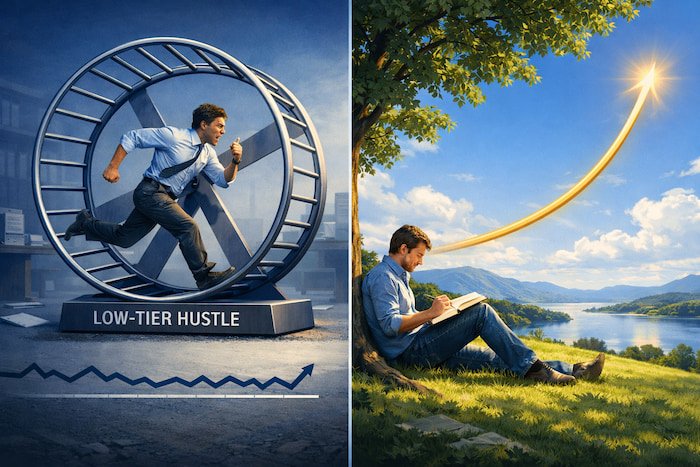
Motion is not momentum.
Effort is not leverage.
2. Hidden Costs Quietly Erase Profits
Side hustles often look profitable on paper, until reality shows up.
Costs include:
- Supplies
- Gas
- Materials
- Time
- Emotional energy
- Stress
By the time those costs are accounted for, the “extra” income often disappears.
This is why many people feel busy but financially unchanged. 📉
3. Opportunity Cost Gets Ignored
Those 10–20 weekly hustle hours could have been invested into:
- Sharpening a high-income skill
- Deepening a profitable craft
- Studying money psychology
- Building systems
- Or simply resting so your brain performs better
Less noise creates more upside.
This distinction matters because not all effort compounds, a theme that shows up repeatedly in long-term financial thinking.
4. Hustling Is Often Fear-Driven, Not Strategy-Driven
Fear of falling behind.
Fear of missing out.
Fear of not “doing enough.”
Fear-based hustling pushes people into low-return work that feels productive but leads nowhere.
Psychologists frequently point out that fear narrows decision-making and shortens time horizons… a dynamic discussed widely in behavioral research summaries at Psychology Today.
What Actually Makes a Side Hustle Worth It
Not all side hustles are traps, only unintentional ones.
A high-quality side hustle does one or more of the following:
✓ Builds a skill that increases long-term earning power
(See High-Income Skills You Can Learn From Home — Even If You Start at Zero)
✓ Creates something once → earns multiple times
(Digital products, assets, automation)
✓ Aligns with your natural strengths
Some work compounds faster because it fits you.
✓ Scales without demanding more hours
If it feels like a second job, it will remain a second job.
Examples of high-leverage side hustles:
- Consulting
- Digital products
- Content creation
- Skill-based freelancing
- Automation-driven services
This long-term framing aligns with how capital efficiency is discussed in mainstream finance education, including guidance shared by firms like Fidelity around sustainable wealth-building behavior.
The Mindset Shift: Intentional Income 🔄
Instead of asking:
“How do I earn more money?”
Ask:
“What kind of income grows with me?”
That shift changes everything.
It’s the difference between:
- Running yourself into the ground
- Planting income trees that bear fruit later 🌳
This question also connects with the deeper emotional relationship many people have with “enough,” explored in The Psychology of “Enough” — The Most Underrated Wealth Skill.
A Simple 3-Question Filter
Before starting any new side hustle, ask:
1. Does this increase my earning power long term?
If not, it’s probably a distraction.
2. Does this scale beyond my hours?
If not, it’s a second job.
3. Does this move me toward — not away from — the life I want?
Wealth-building is lifestyle design as much as income design.
If the answer isn’t a clear yes…
it’s not a side hustle — it’s noise.
Final Word: Productivity Isn’t the Goal — Freedom Is
Side hustles aren’t the enemy.
Unintentional side hustles are.
Real wealth doesn’t come from adding more labor.
It comes from adding leverage.
From stacking the right skills.
From building the right systems.
From making decisions that compound over time.
Your goal isn’t to be busy.
Your goal is to be free. ✨
Build wisely.
Plant intentionally.
Your orchard grows from the seeds you choose. 🌱