

This week, I found myself thinking about a subject I’ve mostly kept away from Your Money Orchard.
Trading.
Not investing.
Not long-term portfolio building.
Not the steady, patient, orchard-style approach I usually write about here.
Trading.
And more specifically, the psychology of trading. 📉🧠
With the stock market seeing some of its wildest swings in years, I’ve received several calls and messages from friends, colleagues, and people who know I’ve spent real time in the trenches. Some asked what I thought about specific trades. Others asked whether they should stay in, get out, buy more, wait, or simply stop looking at the screen.
But beneath the questions about charts, prices, and timing, I heard something deeper.
Fear.
Excitement.
Confusion.
Urgency.
Regret.
Hope.
In other words, I heard Wealth Psychology playing out in real time.
And it made me wonder whether Your Money Orchard should eventually include a careful, grounded series on trading psychology.
Not hype.
Not signals.
Not “how to get rich from home.”
Not the salesy gimmicks that flood people’s feeds whenever volatility rises.
Something much more honest.
A series about what actually happens inside a trader’s mind when money, uncertainty, ego, fear, and speed collide.
Why This Topic Feels Different
I’ll be honest: trading psychology would probably be one of the more controversial areas within Your Money Orchard.
Trading attracts strong opinions. Some people treat it like gambling. Some treat it like a profession. Some sell it as a dream. Others warn against it entirely.
And the market itself doesn’t exactly create a peaceful environment. Prices can move violently. Headlines can shift sentiment in minutes. One day can feel like opportunity. The next can feel like punishment. If you trade, I know you’re reading this nodding your head.
That’s why I would never want to approach this topic casually.
Trading touches volatility, risk, identity, discipline, and sometimes even a person’s sense of self-worth. It can stir up battles within the mind and soul while battles are already happening on the screen.
A trader may think they are fighting the market.
But very often, they are fighting themselves.
That is not a small subject.
It deserves humility.
The Market Does Not Just Test Your Strategy
During volatile weeks, people often assume the main question is:
“What should I buy?”
Or:
“Should I sell?”
Or:
“Is this the bottom?”
But the deeper question is often:
“What part of me is trying to make this decision right now?”
Is it patience?
Is it panic?
Is it revenge?
Is it boredom?
Is it greed dressed up as confidence?
Is it fear pretending to be wisdom?
This is where trading becomes psychologically intense.
The market does not just test your strategy.
It tests your nervous system.
It tests whether you can sit with uncertainty without demanding immediate relief.
It tests whether you can accept being wrong without spiraling (this was a big one for me).
It tests whether you can separate your identity from the outcome of a single decision.
And for some people, that test becomes very expensive.
The Dangerous Myth of “Just Follow the Plan”
A lot of trading advice sounds clean from the outside.
“Just follow your rules.”
“Control your emotions.”
“Cut your losses.”
“Let winners run.”
“Don’t overtrade.”
All of that may be true.
But anyone who has actually traded knows those statements are much easier to say than to live.
When real money is moving, when the candle is flying, when you missed the entry, when you exited too early, when you watched something rip without you, when you took a loss and immediately want to make it back — the mind changes.
The body changes.
Your breathing changes.
Your focus narrows.
Your story-making machine wakes up.
Suddenly, the trader who had a plan becomes a person seeking emotional relief.
That is why psychology matters so much.
Rules are not enough if you do not understand the part of you that breaks them.
Trading Psychology Is Money Identity Under Pressure
This is where trading connects naturally to the broader YMO framework.
In Money Identity: How Your Self-Image Shapes Your Net Worth, I wrote about how the story we carry about ourselves quietly shapes our financial behavior.
Trading compresses that idea into a much smaller window.
An investor may wrestle with identity over months or years.
A trader may wrestle with it in minutes.
One losing trade can awaken old stories entrenched in your psyche:
“I always mess this up.”
“I’m not disciplined.”
“I knew I should have waited.”
“I have to make this back.”
“I can’t let today end red.”
“I’m smarter than this.”
And once those stories take over, the trade is no longer just a trade.
It becomes a referendum on the self.
That is dangerous.
Because when money decisions become identity repair, people stop making clean decisions.
They start chasing relief.
This Is Where Self-Understanding Can Prevent Real Damage
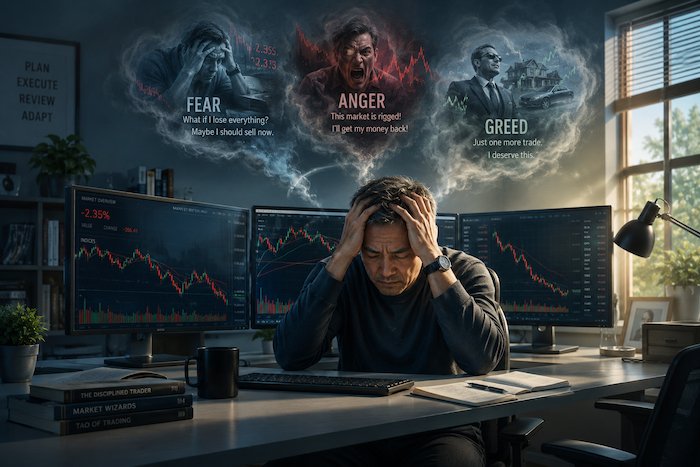
I have seen how a lack of self-awareness can hurt people financially.
Not because they are unintelligent.
Not because they are lazy.
Not because they “don’t get it.”
But because they are making decisions from emotional states they do not recognize.
Fear can feel like caution.
Greed can feel like conviction.
Revenge can feel like determination.
Overconfidence can feel like experience.
And hesitation can feel like wisdom, even when it is really fear of being wrong.
This is why understanding yourself is not soft. It is not optional. It is not some extra mindset layer floating above the “real” financial work.
In trading, self-understanding can be a financial safety mechanism.
It can stop someone from doubling down when they are emotionally compromised.
It can help someone step away after a loss instead of spiraling into revenge trades.
It can remind someone that preserving capital is not weakness.
It can save someone from turning one bad decision into a financial collapse.
That matters.
Why I’m Only Considering This for Now
I’m not announcing a trading psychology series today.
I’m considering it.
And I think that distinction matters.
Your Money Orchard is built around calm, long-term thinking. It is not a site designed to encourage speculation, urgency, or financial adrenaline.
So if I do write about trading psychology, it would need to be done carefully.
The purpose would NOT be to convince anyone to trade.
The purpose would be to help those who already find themselves drawn into trading, market timing, short-term decisions, or emotionally charged financial choices understand what is happening inside them.
It would be educational.
It would be grounded.
It would be risk-aware.
It would likely discuss tools, platforms, account structures, and educational resources only through the lens of decision quality and behavioral safety — not as shiny objects or shortcuts.
Because the moment financial content starts selling urgency, the orchard starts drying out.
The Line Between Education and Seduction
This is one of my biggest concerns.
Trading content can become seductive very quickly.
A chart looks clean after the fact.
A screenshot of gains creates envy.
A confident voice can make risk sound simple.
But markets are not simple.
Neither are people.
The U.S. Securities and Exchange Commission’s investor education site, Investor.gov, consistently emphasizes the importance of learning, understanding risk, and making informed decisions. That principle matters even more when decisions become faster, more emotional, and more vulnerable to impulse.
Good financial education should slow people down enough to think clearly.
It should not emotionally corner them into action.
That would be the standard for any trading psychology series on YMO.
Not “here’s what to buy.”
More like:
Here is why you want to act right now.
Here is what fear feels like in your body.
Here is how overconfidence disguises itself.
Here is why your worst trades often happen after your best ones.
Here is how to build rules that protect you from yourself.
That is the kind of discussion I think may actually help people.
The Orchard Still Comes First 🌱
Even if I eventually explore trading psychology, the heart of Your Money Orchard will remain the same.
Patience.
Process.
Structure.
Self-knowledge.
Long-term growth.
Trading is not the orchard.
But trading psychology may reveal something important about the orchard’s soil.
Because money pressure exposes what is buried.
It shows us where we are calm and where we are reactive.
Where we are disciplined and where we are impulsive.
Where we are patient and where we secretly crave rescue.
And if we can study those patterns honestly, without shame, we can become better stewards of our financial lives.
Not just better traders.
Better decision-makers.
Final Thought
This week reminded me that volatility does not only move markets.
It moves people.
It shakes loose fear, hope, ego, regret, and the old stories we carry about money.
That is why trading psychology may deserve a place in the broader conversation at Your Money Orchard — not because trading is for everyone, but because the psychology underneath it touches everyone who has ever made a money decision under pressure.
For now, I’m simply considering the idea.
Carefully.
Because if I do write about it, I want it to serve the reader, not stimulate them.
I want it to bring clarity, not adrenaline.
And I want it to remind us that sometimes the most important chart is not the one on the screen.
It is the one inside ourselves.
Next Step: If market noise has been pulling at your attention, read The Sunday Harvest: The Wealth of Quiet Waters — a reflection on stillness, financial noise, and why calm may be one of the most underrated money skills.
See you at next week’s The Sunday Harvest!