

February has a way of telling the truth.
The lights are down. The decorations are packed away. The credit card statements, however, are very much still here… and for many households, they’re louder now than they were in December. 📉
This week, a reader reached out to me with a familiar knot in her stomach. She had always managed her credit cards responsibly. Most months, she paid them off in full. Occasionally, she carried a small balance, nothing alarming.
Then the holidays arrived.
Prices were higher than expected (food, gifts, everything!). A car issue popped up at the worst possible time. There was no emergency fund to absorb the hit. So she did what many reasonable people do under pressure: she leaned on her credit card a little more than usual.
By last month, that balance had ballooned close to $4,000.
Now it’s February 2026. The celebrations are over. The bills are real. And the interest rate… north of 20%… feels like it’s quietly choking off her ability to get ahead. I’ve said it before and I’ll say it again: high interest rate debt is the financial devil.
She wasn’t reckless. She wasn’t irresponsible. She was human.
And right now, there are a lot of people standing exactly where she is.
This week’s Sunday Harvest is about how to step back from that edge calmly, without panic, shame, or spiraling… and how to use one very specific tool sparingly and intentionally to reset your footing.
If this moment feels familiar, you’re in the right place. 🌳
(And if you’re new here, this article sits within our broader Money Skills hub, where we focus on practical systems that support long-term financial stability.)
February Is Where Deferred Stress Shows Up 🧠
December has momentum. January has optimism. February has reality.
By now, many people are seeing the downstream effects of decisions that were made quickly, emotionally, or under pressure a few months ago. Credit cards are often where that pressure concentrates, not because they’re inherently bad tools, but because they magnify mistakes when balances grow too large.
Here’s the quiet truth most statements don’t explain well:
If you typically keep your credit card balance at zero, or even in the low hundreds, high interest rates don’t pack much of a punch. The math simply doesn’t have enough surface area to hurt you.
But once a balance crosses into the thousands, especially around $3,000–$4,000+, things get ugly fast.
Let’s make this concrete.
What High Interest Really Does to a $3,900 Balance 📊
Imagine this scenario:
- Credit card balance: $3,900
- APR: 23%
- Monthly payment: $500
At first glance, $500 sounds responsible. And it is — emotionally. But mathematically, interest changes the story.
At 23% APR, that balance accrues roughly $75 in interest every month early on. That means:
- Nearly 15% of each $500 payment is going toward interest at the beginning
- Your actual progress toward the balance is slower than it feels
- The psychological fatigue builds because effort ≠ visible momentum
You’re doing the “right thing,” yet the number barely moves.
This is often where people get discouraged, give up, or worse, start using the card again to relieve pressure. That’s the spiral.
And this is exactly the moment where a specific, limited technique can help.
A Tool I’ve Used Myself (But Only When It Truly Matters)
I’ve been here. Not in theory — in real life!
There was a time when a balance crept higher than I intended. The interest rate wasn’t outrageous by industry standards, but it was high enough to quietly sabotage my progress. Paying aggressively felt exhausting because the interest kept reappearing like a tax on momentum.
What helped wasn’t willpower.
It was removing friction.
Here’s the technique: and I want to be very clear about how and when it should be used.
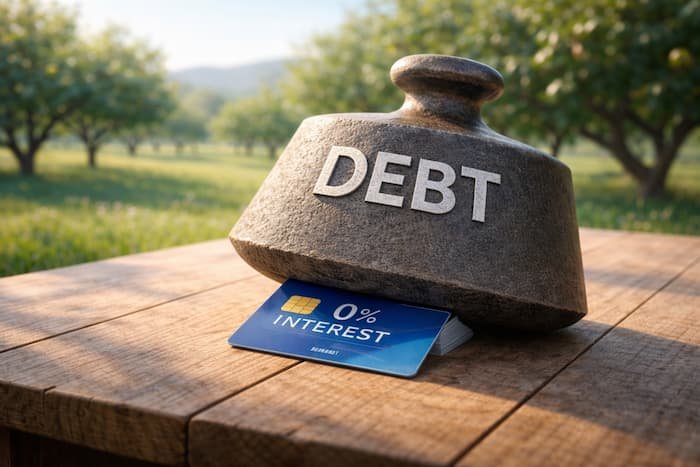
The Strategic Use of 0% APR Intro Offers 🌱
If you have a decent credit score and a clear intention to reduce your balance, one of the most effective tools available is a 0% APR introductory balance transfer.
These offers are everywhere in February… banks compete heavily at the start of the year. Many provide:
- 0% interest on transferred balances
- Intro periods lasting 12–15 months
- A one-time balance transfer fee (often 3–5%)
That $3,900 balance? Once transferred, it accrues zero interest during the promo period.
Zero.
That single shift changes everything.
Let’s run the same numbers again.
The Same $3,900 — Without Interest 🧮
- Balance: $3,900
- APR: 0% (intro period)
- Monthly payment: $500
Now every dollar of your payment reduces the balance.
At $500 per month, you’d pay off:
- $3,600 in 7 months (vs approx. 9 months with interest accruing)
- Leaving a tiny remainder that can be cleared quickly
No interest drag. No psychological erosion. No feeling like you’re running uphill on loose gravel.
The contrast is dramatic, not because the payment changed, but because the structure did.
This is why, when used intentionally, 0% APR offers can act as a pressure release valve, not a loophole.
(For a deeper look at how systems outperform discipline alone, this connects closely with The Beginner’s Guide to Automated Money: Let Systems Make You Rich, which explores why structure often matters more than effort.)
Important Boundaries (This Is Not a Lifestyle Strategy)
This tool works because it is not abused.
A few firm guardrails matter here:
- This is not for ongoing spending
- This is not for hopping balances endlessly
- This is not a substitute for an emergency fund
It’s a bridge, not a destination.
Used once, during a moment of strain, it can help you regain control and rebuild confidence. Used repeatedly, it becomes a crutch that creates long-term fragility.
If you’re curious about how credit card interest actually compounds behind the scenes, the Consumer Financial Protection Bureau explains it clearly in plain language… a helpful reference when making informed decisions.
The Emotional Reset Matters as Much as the Math
There’s something subtle but powerful that happens when interest disappears!
You stop feeling punished.
You stop bracing every time a statement arrives.
You start seeing progress again, which restores agency, not just cash flow.
That psychological relief is often what allows people to make the next smart move: building a starter emergency fund, re-aligning spending, or putting simple safeguards in place.
This is very much aligned with the deeper work we explore in the Money Skills hub, where the goal isn’t perfection, but resilience.
If You’re Reading This and Nodding Quietly
If February feels heavy right now, you’re not behind.
You’re simply seeing the truth earlier than most.
High-interest debt doesn’t mean failure. It means the system needs adjustment. And sometimes, the most responsible move is not grinding harder, but changing the terrain so effort actually works.
Use the tool if you qualify. Use it once. Use it deliberately.
Then close the loop.
🌳
Next Step
If this topic resonated, you may also find clarity in another recent Sunday Harvest articles.