
A Sunday Harvest with a Tech Corner twist
There are certain upgrades in life that feel dramatic right away, and then there are the ones that quietly work their way into your nervous system until one day you realize you would genuinely hate to go back.
That’s how EV ownership has felt for me.
This afternoon, I was out doing what has become a surprisingly enjoyable part of my week: covering a lot of ground in the EV without really thinking much about the cost of doing it. I had my coffee with me, the cabin was quiet, and the miles just kept unfolding in that smooth, almost surreal way electric driving has. It struck me again how different this feels from the old rhythm of driving I had accepted for years without questioning it.
No stop at the gas station.
No subtle mental note that I’d need to fill up soon.
No background irritation over what the drive was “costing me.”
Just a full charge, a clean windshield, a calm road, and the sense that I was free to move.
That feeling has become one of my favorite unexpected benefits of driving electric. People talk about the torque, the tech, the novelty, and the fuel savings, and those things are all real, but the deeper benefit, at least for me, has been psychological. There is something incredibly satisfying about unplugging the car in the morning and knowing I’m already topped off for the day.
That simple act changes the emotional tone of driving.
You don’t realize how much attention gas takes up until it no longer does. It’s not just the expense. It’s the mental drag. The recurring obligation. The mild but constant need to monitor, plan, stop, swipe, wait, and pay. With an EV, especially when you’re in a habit of topping up at night, that whole layer disappears.
And in my case, it gets even better.
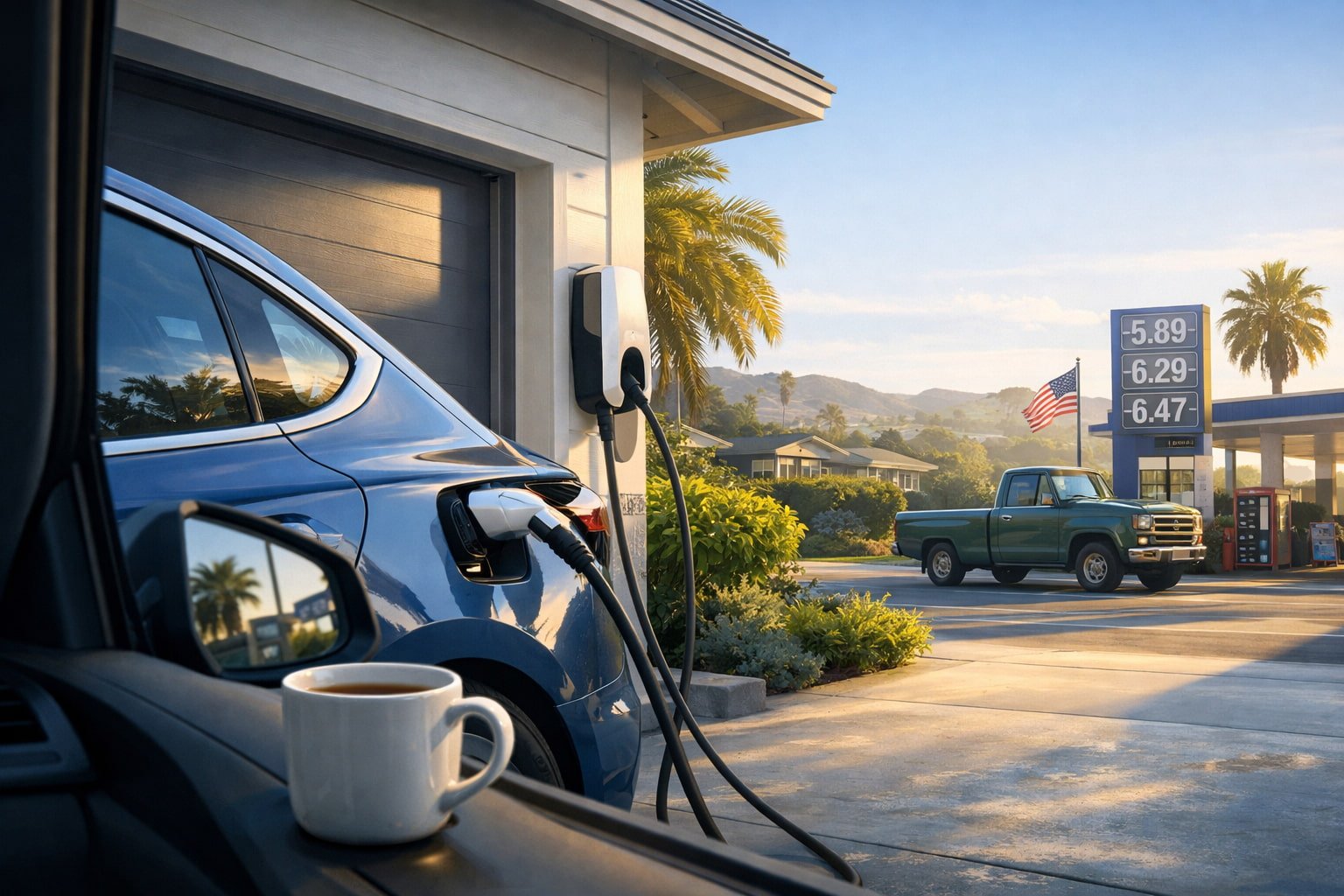
One of my properties has garage electricity covered by the HOA, which means charging there is effectively free. Every time I think about that, I smile a little. Free charging is one of those real-world details that makes EV ownership feel even more rewarding than the brochures or specs could ever explain. It’s not just that the operating cost is low. It’s that on some days, it feels like I’m driving around on a system that is quietly working in my favor.
That’s a rare feeling in modern life.
So many things seem designed to pull money away from us in small, steady drips. Subscriptions, fees, inflated convenience costs, impulse spending, maintenance surprises. EV ownership, at least the way I experience it, feels like one of the few consumer decisions that consistently gives something back. Month after month, it feels like more money stays in my pocket.
And I notice it even more because I still occasionally drive my old truck.
Ahhhh, I have affection for that ‘ol truck! It has history. It has presence. It has that old-school, dependable feel that makes you appreciate mechanical things. But every time I drive it now, the contrast is impossible to ignore. Pulling into a California gas station in an older truck feels like entering a very different financial reality. You watch the numbers climb. You feel that little sting in your chest. And with gas threatening to brush up against $7 bucks a gallon in parts of California, there’s no pretending it’s minor.
It hurts.
Not in a dramatic, life-ruining way. Just in that very ordinary, annoying way that makes you think, There goes more money again.
That’s the thing about gas. For so many households, it’s one of those repeating expenses that gets normalized because it’s familiar. But familiar does not mean harmless. When my wife drives her ICE vehicle to work every day, the gas cost stacks up fast. $300+ a month or more can disappear without much effort. That’s real money. That’s money that could be invested, redirected, saved, used for something meaningful, or simply left alone to reduce pressure elsewhere.
When I compare that to my own experience… plugging in at night, driving on extremely low cost, and in some cases effectively charging for free —it genuinely feels like I’m getting money back in my pocket each month.
That phrase matters to me.
Because financial progress is not always about making giant leaps. Often it comes from removing leaks. Tightening systems. Lowering recurring outflows. Making daily life a little more efficient, a little calmer, and a little less expensive without sacrificing quality. In that sense, the EV does not feel like some flashy gadget purchase. It feels like a practical wealth tool hiding inside a vehicle.
And then there’s the driving experience itself.
One of my favorite little rituals is heading to a client’s office in the morning or early afternoon with coffee in hand. There’s something almost absurdly pleasant about easing into the seat, setting the route, letting the cabin go quiet, and allowing the hands-free driving system to handle part of the load once conditions are right. I’m always attentive. Always ready to take the wheel. But what I love is the shift in my body when I’m no longer making all those constant micro-adjustments that traditional driving demands.
My shoulders relax.
That may sound small, but it isn’t.
Normal driving asks a lot from your nervous system. Tiny steering corrections. Lane centering. Brake modulation. Scanning mirrors. Adapting to uneven traffic flow. It’s not that any one task is overwhelming. It’s that together they create low-grade fatigue, especially over time. With driving assist engaged, the experience changes. The car helps keep itself centered. It responds quickly to changes in traffic. It can brake faster than I could if cars ahead suddenly compress and my eyes happen to drift for a split second.
That support changes the emotional texture of the drive.
The cabin feels quieter. My body feels less braced. The whole trip feels smoother and more civilized. I can mentally review my meeting, think through the day, sip coffee, and arrive feeling composed rather than slightly depleted. It feels less like battling the road and more like cooperating with a system designed to reduce friction.
That matters more than people think.
I’ve come to believe that some technologies are valuable not just because they save time or money, but because they change your baseline emotional state in subtle but meaningful ways. They reduce stress. They reduce vigilance fatigue. They reduce friction. They give you back a little bandwidth. And when a tool can do that while also lowering monthly costs, it starts to fit beautifully into the broader philosophy behind Your Money Orchard.
Because this site has never been only about spreadsheets and investing frameworks.
It’s also about the psychology of systems.
It’s about building a life where your habits, tools, and routines quietly support your peace rather than constantly extracting from it. It’s about noticing where money leaks out through outdated defaults and asking whether there is a better way. It’s about recognizing that financial wellness is deeply connected to emotional wellness. The way we spend, the way we move, the way we structure our days — all of it matters.
That’s why I find EV ownership so interesting. It sits at the intersection of money, technology, and psychology.
There’s the financial side: lower operating cost, lower maintenance burden, fewer routine service needs, less money disappearing into gasoline each month.
There’s the practical side: charging at home, waking up “full,” skipping gas stations, simplifying errands and longer driving days.
And then there’s the mental side, which may be my favorite of all: the strange peace of never worrying about gas, the mild pleasure of plugging in each evening, the confidence that the car is helping me stay safer on the road, and the relief of stepping outside the old weekly ritual of spend, spend, spend.
That last part has become impossible to ignore.
Now when I pass gas stations and see rows of cars lined up at the pumps, I feel no envy at all. If anything, I feel grateful to have stepped out of that pattern. I used to participate in it without a second thought. Now it feels like watching a recurring drain I no longer have to volunteer for.
And that is freeing.
Not because EV ownership is perfect. Not because every household should make the same choice tomorrow. Just because when a system works well for your life — financially, practically, psychologically — you feel it. You feel it in your monthly budget. You feel it in your shoulders. You feel it in the smoothness of your routines. You feel it in the way an ordinary Tuesday becomes just a little easier.
That kind of ease is easy to underestimate.
But I’ve learned that much of wealth-building is really the art of creating more ease with less leakage.
Sometimes that looks like automating savings.
Sometimes it looks like lowering a recurring bill.
Sometimes it looks like choosing a calmer tool for a daily task.
And sometimes, apparently, it looks like plugging in your car each night and waking up ready to go.
That may not sound romantic, but to me it feels like a kind of quiet luxury.
A practical one.
A grounded one.
A modern one.
And on afternoons like today, when I’m rolling comfortably through a full day of driving in near silence, coffee nearby, money staying where it belongs, I can’t help but think this is exactly the kind of technology I like best: the kind that makes life feel freer, not busier.
That feels like a harvest worth noticing. ⚡🌿