
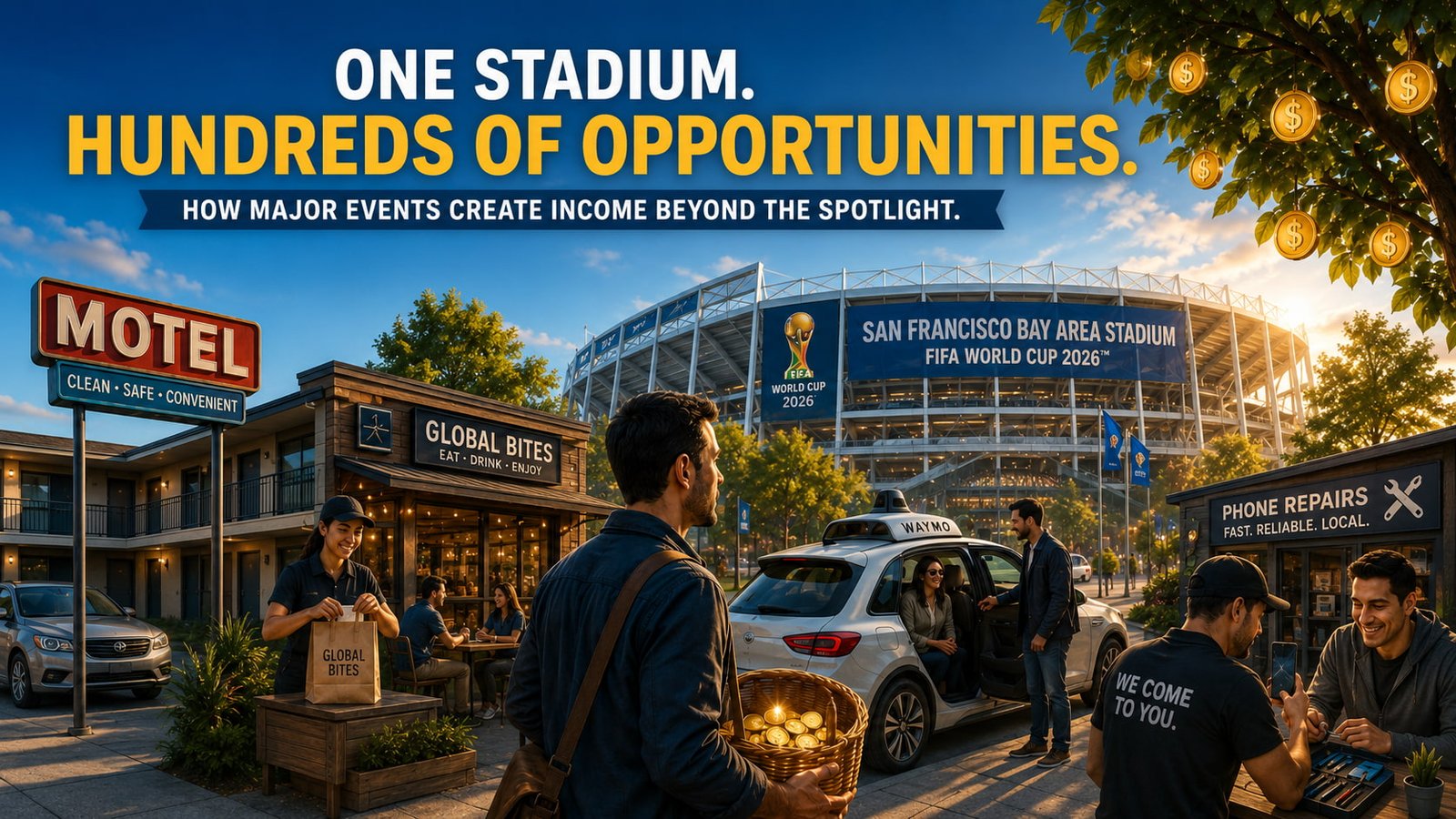
For a few remarkable weeks, the center of the soccer world landed right here in the Bay Area.
Levi’s Stadium—temporarily renamed San Francisco Bay Area Stadium for the tournament—hosted six World Cup matches between June 13 and July 1. Tens of thousands of people arrived from different states, countries, and cultures. They needed places to sleep, food to eat, transportation, entertainment, directions, phone chargers, clean clothes, and countless other things that had nothing to do with kicking a soccer ball.
The tournament is still moving toward its final weekend, but the Bay Area portion is already behind us. And as I reflect on what just happened locally, I keep returning to one of the central ideas inside Earning & Income:
Income grows when we learn to notice where value is needed—not only where attention is focused.
The players occupied the field.
But an entire economy formed around them.
The World Cup Was Much Bigger Than Soccer ⚽
According to the official Bay Area World Cup schedule, six matches were played at Levi’s Stadium, culminating in the United States’ Round of 32 victory over Bosnia and Herzegovina on July 1.
Those matches were the visible event.
But surrounding each match was a much larger network of economic activity:
- Hotels and short-term rentals
- Restaurants, bars, food trucks, and delivery services
- Drivers, public transit workers, and parking operators
- Security personnel and event staff
- Translators and multilingual guides
- Laundry and cleaning services
- Retailers and merchandise sellers
- Photographers and content creators
- Phone repair technicians
- Travel planners and local tour operators
- Technology and payment platforms
- Childcare providers and pet sitters
- Temporary staffing agencies
- Property owners and maintenance workers
Most of these people never stepped onto the field.
Many probably never entered the stadium.
Yet they still participated in the World Cup economy.
That distinction matters because we often misunderstand how opportunity works. We assume the largest rewards go only to those standing at the center of an industry.
But very often, the more accessible opportunities exist around the edges.
A Motel Three Blocks From the Action
A friend recently shared a story that made this idea feel very real to me.
He lives in Granite Bay but works in Silicon Valley. For anyone unfamiliar with that drive, it can easily approach three hours depending on traffic—and sometimes it feels even longer.
Fortunately, he only needs to be physically present at work twice a week.
Instead of renting a small apartment near the office, signing a long lease, buying furniture, and taking on another layer of responsibility, he developed a simpler arrangement: he rents a room at an inexpensive motel near work.
The motel is safe, clean, and convenient. It gives him exactly what he needs without a major commitment.
Personally, I think this is a clever example of matching the solution to the actual problem. He does not need a second home. He needs a clean bed two nights a week.
Then the World Cup arrived.
The motel was only about three blocks from the stadium, and for a period of time, its rates nearly tripled.
That alone caught his attention. But what really opened his eyes was everything happening around the room.
During each visit, he needed laundry service. He ordered meals from nearby restaurants. He paid local drivers to take him to meetings. He even tried Waymo, which he thought was incredibly cool.
Then, amid all the movement and activity, he dropped his phone and cracked the screen.
Rather than spending half a day searching for a repair shop, he found a mobile phone-repair service that came directly to him.
A motel room led to laundry.
Laundry led to delivery.
Work meetings led to transportation.
Transportation introduced him to a new technology platform.
A cracked phone created an opportunity for a mobile technician.
As he described it to me, the entire area felt like a bustling soup of commerce.
I loved that description because it captures what an economy really is.
It is not a neat row of isolated transactions.
It is a living web of human needs.
Demand Travels in Chains
When thousands of people arrive for a major event, they do not create only one kind of demand.
They create a chain.
A visitor books a hotel room.
The hotel needs additional cleaning staff.
The cleaning staff needs transportation.
The visitor orders dinner.
The restaurant needs more ingredients, packaging, cooks, and delivery drivers.
The visitor attends a watch party.
The venue needs security, audio equipment, temporary furniture, signage, and payment processing.
The visitor loses a charger.
A nearby retailer makes a sale.
The visitor gets a stain on an expensive jersey.
A laundry service receives an urgent request.
One person’s arrival can generate income for people across an entire local network.
This is the deeper lesson:
Opportunity often appears as a sequence of connected problems.
The person who sees only the headline notices the World Cup.
The person who sees the economic chain notices lodging, transportation, food, repairs, translation, convenience, and time pressure.
🌱 The event attracts attention. The surrounding needs create income.
The Quiet Operator Behind the Crowd
The second story I keep thinking about is not one specific person. It is a composite of the kinds of quiet operators who become visible whenever a major event changes the rhythm of a city.
Imagine a woman working a regular administrative job during the week.
On weekends, she occasionally helps small restaurants photograph their food, update menus, and create simple social-media posts. She is not running a large agency. She has a good eye, knows how to write clearly, and understands a few basic design and scheduling tools.
When the World Cup arrives, several restaurants near the stadium suddenly need help.
One needs a special match-day menu.
Another wants short videos showing international fans gathering outside.
A third wants its menu translated so visitors can understand the offerings more easily.
She asks her teenage son to help with video editing. She uses a scheduling platform to organize the work, a payment app to collect deposits, and a simple cloud folder to keep each client’s photos organized.
By the end of the tournament, she has not become an overnight millionaire.
But she has gained three new clients.
She has learned which services restaurants value most.
She has developed a reusable match-day content package.
And one of the restaurant owners asks whether she can continue helping after the tournament ends.
I like this story because nothing about it is flashy.
She did not invent a revolutionary product.
She did not quit her job impulsively.
She simply combined a few useful skills and stepped closer to a growing need.
That is often how durable earning power begins.
Income Often Grows One Step Away From the Obvious
When people think about making money from professional sports, they tend to imagine becoming an athlete, coach, agent, broadcaster, or team owner.
Those are the obvious positions.
They are also among the hardest positions to obtain.
But you do not need to play in the World Cup to benefit from the activity surrounding it.
You might help a restaurant serve fans faster.
You might transport visitors more reliably.
You might create neighborhood guides in multiple languages.
You might help landlords prepare rooms.
You might repair phones, deliver food, photograph events, manage reservations, or create content for businesses suddenly receiving more attention.
This is where skill stacking becomes one of the most underrated ways to increase your income.
The opportunity may not come from mastering one extraordinary skill.
It may come from combining several ordinary ones:
- Driving + local knowledge + reliability
- Photography + basic design + social media
- Language skills + hospitality + organization
- Cleaning + scheduling + customer service
- Cooking + delivery + cultural knowledge
- Technology + repair skills + mobile service
- Writing + research + local experience
Each skill may be common on its own.
The combination can be rare.
And rare combinations are valuable because they solve problems in ways that are difficult to replace.
Follow the Need, Not the Headline 🧠
There is an important psychological difference between chasing trends and observing needs.
Chasing trends usually begins with anxiety:
Everyone is making money from this. I need to hurry.
Observing needs begins with curiosity:
What has become more difficult because this is happening?
The first mindset pushes us toward imitation.
The second encourages us to think.
That difference protects us from wasting money on unnecessary courses, expensive tools, complicated platforms, or business ideas we do not understand.
A major event does not automatically create a good opportunity for everyone.
The better questions are:
1. Who is arriving?
Visitors, workers, vendors, media crews, families, corporate guests, and international fans may all need different things.
2. What becomes inconvenient?
Traffic increases. Restaurants become crowded. Laundry piles up. Transportation becomes uncertain. Visitors struggle with directions and unfamiliar systems.
Inconvenience is often where people willingly pay for help.
3. What becomes urgent?
A broken phone during a trip is more urgent than a broken phone at home.
A last-minute ride to a meeting is more urgent than planning next week’s commute.
Urgency increases the value of speed and reliability.
4. What can I solve with skills I already possess?
The best opportunity may not require rebuilding your life.
It may require repackaging what you already know.
5. Can the relationship survive after the event?
A temporary event becomes more valuable when it creates permanent customers, stronger systems, better tools, or a clearer business offer.
That final question separates a brief income spike from something that can continue growing.
Not Every Big Event Creates a Big Personal Win
It is worth staying grounded here.
Large economic projections can make major events sound as though money simply rains down on a host city.
Reality is more complicated.
A recent Reuters analysis of the World Cup’s economic effects found that host cities were experiencing increased hospitality spending, but the overall gains were more modest than some people expected.
That does not mean opportunities were absent.
It means opportunity was unevenly distributed.
A restaurant located near a fan zone may have experienced an exceptional month.
A business far from visitor traffic may have noticed almost nothing.
A hotel owner may have increased rates dramatically.
A worker may have received only a few extra shifts.
A vendor may have enjoyed record sales but also paid higher staffing, supply, insurance, and transportation costs.
Revenue is not the same as profit.
Activity is not automatically wealth.
And being close to a trend does not guarantee that we are positioned to benefit from it.
That is why structure matters.
Good opportunities still require pricing, capacity, customer service, expense control, and a sensible account structure. Additional income should be tracked separately, taxes should be considered, and temporary gains should not immediately become permanent lifestyle expenses.
The orchard lesson remains the same:
A busy season produces fruit only when the roots and branches can support it.
What Local Businesses Actually Experienced
The effects were very real for some Bay Area businesses.
KTVU reported that Clara’s Junction, located near Levi’s Stadium, expanded from five operating days per week to seven during the tournament. Its general manager said some game days brought the equivalent of a normal week’s business.
That is an extraordinary surge.
It is also a demanding one.
More customers require more food, more staff, more cleaning, more scheduling, and more emotional energy. Opportunity does not always arrive gently. Sometimes it arrives all at once and asks whether your systems are ready.
This is why the right tools and platforms can matter—not because technology magically creates income, but because good systems help a person handle demand without becoming overwhelmed.
A simple scheduling system may prevent missed appointments.
A separate business account may make income and expenses easier to track.
A customer relationship tool may help turn a first-time buyer into a repeat customer.
An educational resource may help someone understand pricing, taxes, insurance, or basic bookkeeping before a temporary opportunity becomes a financial mess.
Tools should support clarity.
They should not become another distraction.
Turning Temporary Attention Into Durable Income
A World Cup match lasts about 90 minutes.
The surrounding business opportunity may last several weeks.
But the value created during that period can continue much longer when people act intentionally.
Someone who earns additional income from an event can use it to:
- Strengthen an emergency fund
- Pay down high-interest debt
- Purchase equipment that improves future work
- Develop a repeatable service package
- Build a basic website or booking system
- Fund training that deepens an existing skill
- Create a separate account for taxes and business expenses
- Gather customer reviews and referrals
- Document the process for future events
- Invest part of the proceeds for long-term growth
The goal is not merely to earn more during an unusual month.
The goal is to convert a temporary window into greater long-term capability.
That might mean money.
But it might also mean relationships, experience, confidence, better systems, or proof that people will pay for something you can provide.
Sometimes the most valuable harvest is evidence.
Evidence that your skill has value.
Evidence that your idea works.
Evidence that you can solve a real problem.
The Psychological Barrier: “That Opportunity Isn’t for Me”
One reason people miss adjacent opportunities is that they mentally disqualify themselves.
They see the World Cup and think:
I’m not involved in professional sports.
They see a technology boom and think:
I’m not an engineer.
They see a housing trend and think:
I’m not a real-estate investor.
They see businesses growing online and think:
I don’t have enough followers.
This is status-based thinking.
We become so focused on the most visible participants that we overlook the people quietly supplying them.
You may not be the architect.
But perhaps you provide the materials.
You may not own the restaurant.
But perhaps you improve its delivery system.
You may not build the platform.
But perhaps you teach customers how to use it.
You may not organize the event.
But perhaps you solve one of the hundreds of problems the event creates.
Opportunity does not always require permission from the center.
Sometimes it begins by becoming useful at the edge.
A Practical Harvest for This Week 🌱
Think about one major change happening around you right now.
It could be:
- A large local event
- A new company moving into the area
- A new technology being adopted
- A neighborhood growing quickly
- A workplace changing its systems
- An aging population needing different services
- Parents struggling with time
- Small businesses overwhelmed by administration
- People trying to understand unfamiliar financial tools
Then ask:
What new needs are forming around this change?
Do not begin by asking how to make the most money.
Begin by asking how to become more useful.
Which problems are becoming more frequent?
Which tasks are people avoiding?
Where are they losing time?
What feels confusing, inconvenient, or stressful?
Which two or three of your existing skills could be combined into a simple solution?
You do not need to launch a company tomorrow.
You can start by observing.
Talk to people.
Notice repeated complaints.
Test one small offer.
Use simple tools.
Keep commitments manageable.
Let real demand teach you what to build.
That is a calmer and more intelligent form of entrepreneurship than chasing whatever happens to be trending online.
Final Thought: The Stadium Was Only the Center
The World Cup placed a spotlight on one Bay Area stadium.
But the economic story stretched far beyond the field.
It reached the motel three blocks away.
It reached the laundry service.
It reached the restaurant kitchen.
It reached the driver navigating unfamiliar traffic.
It reached the mobile technician repairing a cracked phone.
It reached the content creator helping a small business speak to a new audience.
That is what I will remember most.
Not simply that one of the world’s largest sporting events came to our community, but that it revealed how many forms opportunity can take.
The players gave people a reason to gather.
Everyone else helped make the gathering possible.
And somewhere inside that bustling soup of commerce is a lesson for all of us:
You do not always need to stand at the center of the action.
You need to understand what the action causes.
Follow the needs.
Build useful skills.
Create simple systems.
Serve people well.
Then take part of whatever you earn and plant it somewhere that can keep growing after the crowd goes home.
Next Step: The Sunday Harvest: When “Slow and Steady” Needs a Growth Spurt